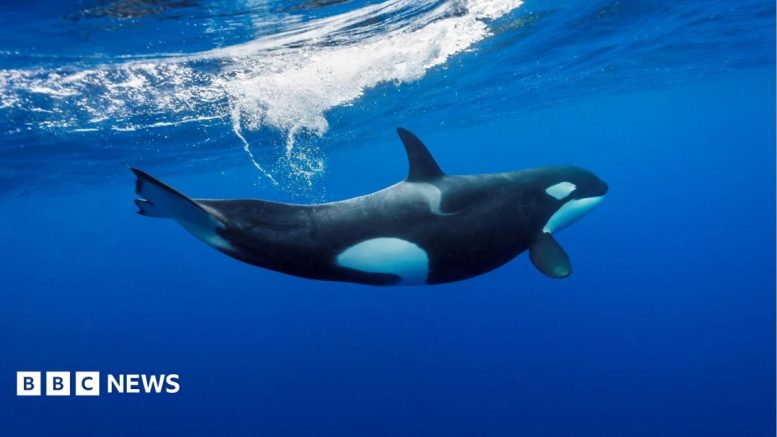

The scientists also studied a tooth taken from Lulu, a member of a group of orcas known as the West Coast Community.
Lulu was found dead on a shoreline on the Isle of Tiree, in the Inner Hebrides, in 2016.
The scientists said her tooth carried a different type of “radioactive fingerprint” – one known as the Sellafield signal.
It was produced by radiocarbon discharges into the Irish Sea from the Sellafield nuclear reprocessing facility in Cumbria and carried by currents to the west of Scotland where Lulu hunted her prey.
The researchers also examined a tooth from a sperm whale nicknamed Moby, whose skull is today on display in the National Museum of Scotland in Edinburgh.
Moby died after he stranded on mudflats along the Firth of Forth in 1997.
Analysis suggested he was at least 43 years old. Again the absence of nuclear weapons fallout in older layers of his tooth helped scientists to work out his age.
The research was led by scientists at SUERC – Centre for the Isotope Sciences in partnership with researchers from the universities of Glasgow, Edinburgh and St Andrews and National Museums Scotland.
The team’s study has been published in the journal, Frontiers in Marine Science, external.
The teeth used in the study were provided from the collection of the Scottish Marine Animal Stranding Scheme (SMASS).